
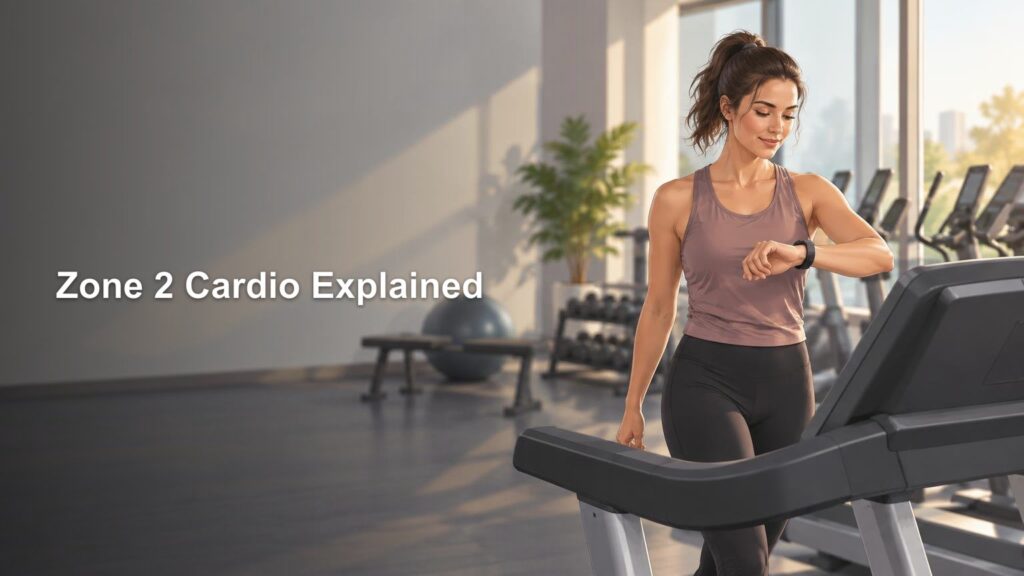
TLDR: Zone 2 cardio is best treated as a sustainable aerobic effort you can maintain while speaking in sentences. The exact heart rate differs among people, and watches do not all define the zone in the same way. Use the talk test first, heart-rate data as supporting information, and choose a pace you can repeat without disrupting your strength training or recovery.
Zone 2 cardio explained simply: it is steady exercise that raises your breathing and heart rate without turning the session into a hard effort. Brisk walking, easy cycling, incline treadmill walking, swimming, rowing, or an elliptical can all qualify if the intensity is appropriate for you.
Its main strength is repeatability. Zone 2 can help beginners accumulate aerobic activity, give experienced lifters a manageable form of conditioning, and offer an alternative to doing every cardio session as a punishing interval workout. It is useful, but it is not a uniquely precise or biologically magical training zone.
What Zone 2 cardio means in practice
There is no single Zone 2 definition used across every laboratory, coaching system, fitness watch, and exercise app. A five-zone consumer heart-rate model may place Zone 2 somewhere different from a laboratory model based on ventilatory or lactate thresholds. A coach using a three-zone endurance model may use the same label differently again.
For everyday fitness, the most useful working definition is a controlled, sustainable aerobic effort. Your breathing is clearly higher than at rest, but it remains organized. You feel as if you are exercising rather than strolling, yet you are not counting the seconds until the session ends.
That practical definition matters because fixed percentages of maximum heart rate or aerobic capacity do not produce identical physiological intensity domains in everyone. A review of exercise-intensity prescription methods found important limitations in using common fixed-percentage formulas to standardize exercise responses across individuals.
Use the talk test before chasing a heart-rate number
The easiest field check requires no watch or laboratory assessment. During the session, try speaking a complete sentence. If you can talk comfortably but would struggle to sing, you are likely around a moderate effort. If you can only say a few words before pausing for breath, you have moved into vigorous exercise according to the CDC’s physical-activity intensity guidance.
The talk test does not locate an individual threshold with laboratory precision. It does, however, answer the practical question most people have: “Am I keeping this controlled, or has it become hard cardio?”
- Too easy: Your breathing is barely different from rest, and you could sing or chat without interruption.
- About right for practical Zone 2: You are breathing more deeply but can still speak in sentences.
- Probably above it: Conversation breaks into short phrases, and maintaining the pace requires concentration.
- Clearly hard: You can manage only a few words at a time and need deliberate recovery afterward.
Do not intentionally slow down every time your breathing changes for a moment. A hill, a short staircase, or a brief increase in resistance can raise the effort temporarily. Look at the overall character of the session rather than trying to produce a perfectly flat line.
Why your watch’s Zone 2 may not match advice online
Wearables commonly estimate zones from an age-based maximum heart rate, a detected maximum, heart-rate reserve, or settings entered by the user. Different formulas and defaults produce different boundaries. Your displayed Zone 2 therefore may not represent the same intensity meant by a coach, researcher, or another app.
Heart rate also changes with conditions. Heat, dehydration, caffeine, fatigue, emotional stress, hills, and accumulated time in a workout can raise it at the same external pace. Exercise mode matters too: the heart rate you see while cycling may differ from what you see while running or walking uphill.
Use your device to identify trends rather than obeying it as an absolute authority. If a pace consistently lets you speak in sentences and complete the session without excessive fatigue, note the corresponding heart-rate range. Over several sessions, that personal pattern is usually more useful than copying a generic online chart.
- Choose one repeatable activity, such as incline walking or stationary cycling.
- Warm up gradually before interpreting your heart rate.
- Settle into a pace that allows sentence-level conversation.
- Record your average heart rate, pace or resistance, duration, and perceived effort.
- Compare similar sessions over time instead of reacting to every short fluctuation.
Which activities can count as Zone 2?
Zone 2 describes intensity, not a particular machine or sport. The right activity is one that raises your effort enough while remaining comfortable, accessible, and repeatable.
| Activity | How to adjust it | Common mistake |
|---|---|---|
| Outdoor walking | Increase pace or choose a gentle incline | Assuming walking is always too easy |
| Incline treadmill walking | Adjust incline before making speed uncomfortable | Holding the rails and reducing the actual workload |
| Stationary cycling | Use resistance and cadence you can sustain smoothly | Turning every ride into a high-resistance leg workout |
| Elliptical | Adjust resistance while keeping movement controlled | Moving so easily that breathing never changes |
| Rowing | Use restrained strokes and consistent technique | Pulling too aggressively and drifting into hard intervals |
| Swimming | Choose an easy, rhythmical stroke and planned rests | Confusing breath-control difficulty with the intended aerobic effort |
| Hiking | Select manageable terrain and slow down on steep sections | Letting every climb become a maximal push |
Walking absolutely can count. For someone new to exercise, level walking may be enough. A fitter person might need a quicker pace or an incline. Body size, conditioning, terrain, and movement economy all influence the effort, so the same treadmill setting will not be Zone 2 for everyone.
Who benefits most from Zone 2 cardio?
Beginners building an aerobic habit
Beginners often need consistency more than complexity. A controlled effort provides room to learn pacing and build weekly activity without requiring repeated all-out work. Start with a duration you can complete comfortably, then add time or frequency gradually.
People combining cardio with strength training
Hard intervals can create substantial fatigue, especially when they involve running, steep climbing, or heavy cycling resistance. Easier aerobic sessions are often simpler to place around lifting because they do not have to become another demanding leg workout. Adults building a combined routine can also use this beginner strength-training guide to establish the resistance-training side of the plan.
People who dislike intense cardio
An exercise plan only works when it survives real life. If hard intervals make you dread training or leave you excessively sore, sustainable cardio is a legitimate primary approach. You do not need to finish every workout exhausted for it to count.
Experienced exercisers adding manageable volume
Runners, cyclists, lifters, and recreational athletes can use controlled sessions to accumulate aerobic work without making every day hard. The benefit comes from fitting an appropriate amount of repeatable work into the total program—not from the Zone 2 label itself.
Zone 2 versus HIIT: choose by purpose
Zone 2 and high-intensity interval training solve somewhat different programming problems. Steady moderate cardio is generally easier to sustain for longer and recover from. HIIT delivers vigorous work in less training time, but the work periods are more uncomfortable and can create more fatigue.
| Consideration | Zone 2-style cardio | HIIT |
|---|---|---|
| Effort | Controlled and conversational | Hard, with recovery intervals |
| Session character | Continuous and steady | Repeated work and recovery periods |
| Recovery demand | Usually lower | Usually higher |
| Time efficiency | Often requires a longer session | Can provide vigorous work in less time |
| Best fit | Building repeatable aerobic volume | Adding a concentrated hard stimulus |
| Main risk in programming | Going too easily to challenge yourself | Doing too much hard work to recover well |
Neither method automatically wins for fat loss. A systematic review and meta-analysis found minimal differences in long-term fat-mass and fat-free-mass changes between interval training and moderate-intensity continuous training. The practical winner is often the option that you can perform consistently while maintaining nutrition, resistance training, sleep, and recovery.
A mixed approach can work well: use controlled sessions for most cardio and add a limited amount of harder work if you enjoy it, recover well, and have a reason to train vigorous intensity. If weight loss is the goal, consider cardio alongside the priorities in this guide to cardio versus weights for weight loss.
Zone 2 is not a fat-loss shortcut
At moderate intensity, the body may use a higher proportion of fat relative to carbohydrate than it does during harder exercise. That does not establish that one Zone 2 workout produces superior long-term body-fat loss. Fuel used during a session and body-fat change over weeks or months are different questions.
Body composition responds to the broader pattern: energy intake, total activity, training consistency, resistance exercise, sleep, recovery, and how well the plan can be maintained. Zone 2 can support that pattern by providing manageable activity. It does not override it.
Claims that Zone 2 uniquely improves mitochondria or creates adaptations unavailable at higher intensities also run ahead of the evidence. A 2025 narrative review found that relatively few studies explicitly prescribed Zone 2 and concluded that evidence for uniquely superior mitochondrial benefits was limited or mixed. Because this was a narrative rather than systematic review, it is best used as a warning against certainty—not as proof that Zone 2 is ineffective.
How much should you do each week?
There is no universal weekly Zone 2 requirement. A more useful benchmark is the federal recommendation that adults accumulate 150 to 300 minutes of moderate-intensity aerobic activity per week, 75 to 150 minutes of vigorous activity, or an equivalent combination. Adults are also advised to perform muscle-strengthening activity on at least two days per week.
That is a public-health target, not a requirement to begin at the full amount. An inactive person might start with short, manageable sessions and build from there. Someone already training regularly can distribute moderate activity around lifting, sports, and harder cardio.
A simple starting structure is two or three conversational sessions during the week. Choose a duration that leaves you capable of repeating the plan the following week. Add time gradually before adding more intensity, especially if you are also increasing strength-training volume.
When heart-rate formulas need extra caution
Generic heart-rate targets are not appropriate for everyone. Beta blockers slow heart rate and can prevent it from rising according to standard formulas. The American Heart Association notes that people taking these medications may need an individualized target, potentially informed by an exercise stress test.
If you take a medication that affects heart rate, use clinician-led guidance rather than trying to force your pulse into a watch-generated zone. People with cardiac disease, concerning symptoms, or other medical circumstances that materially affect exercise should also seek individualized advice before using generic intensity targets.
Frequently asked questions
Is Zone 2 the same as moderate-intensity cardio?
They overlap in many practical fitness discussions, but the terms are not universally interchangeable. “Zone 2” can refer to different ranges depending on the model. For general exercise, a sustainable moderate effort is a useful way to apply the idea without pretending the label has one precise definition.
Should I be able to talk during Zone 2?
Yes. You should generally be able to speak in sentences, although singing would be difficult. If you can only manage a few words before taking a breath, you are probably working at vigorous intensity.
Why is my heart rate higher at the same pace today?
Heat, hydration, caffeine, stress, poor sleep, fatigue, hills, and the length of the session can all affect heart rate. Compare trends across similar workouts instead of treating one reading as a verdict on your fitness.
Can beginners do Zone 2 often?
Many beginners tolerate controlled aerobic exercise well, but frequency should still match current fitness and recovery. Begin with manageable sessions, watch for persistent pain or excessive fatigue, and increase the weekly workload gradually.
Do I need a heart-rate monitor?
No. A monitor can help you track patterns, but the talk test and your sense of whether the effort is sustainable are enough to begin. A device becomes more useful after you learn how its readings correspond with your breathing and perceived effort.
The practical takeaway
Use Zone 2 as a repeatable aerobic-training tool, not a mandatory number. Pick an activity you enjoy, settle into a pace that permits sentence-level conversation, and monitor how well you recover. Let heart-rate data confirm personal trends rather than dictate the session from an unverified formula.
If you are starting from low activity, schedule a manageable walk, ride, or elliptical session this week and finish feeling as though you could have continued. Build consistency first. Once that foundation is reliable, decide whether more duration, strength training, or occasional harder intervals best serves your goal.
References
- An Examination and Critique of Current Methods to Determine Exercise Intensity – PubMed
- Measuring Physical Activity Intensity <B>Error processing SSI file</B><BR>
- Slow and Steady, or Hard and Fast? A Systematic Review and Meta-Analysis of Studies Comparing Body Composition Changes between Interval Training and Moderate Intensity Continuous Training – PubMed
- Much Ado About Zone 2: A Narrative Review Assessing the Efficacy of Zone 2 Training for Improving Mitochondrial Capacity and Cardiorespiratory Fitness in the General Population
- Physical Activity Guidelines for Americans, 2nd edition
- Current Guidelines | odphp.health.gov
- How Do Beta Blocker Drugs Affect Exercise? | American Heart Association